The Puzzle Samen logo: four puzzle pieces with smiling faces
PuzzleSamen

Getting the puzzle ready for you…

The rules, the tiles and the list that decides

Letterio rules: the play, the letter values and the word list

Place words on a 15×15 board, taking turns, with two to four players. Below are the rules in a row, what each tile is worth and how those values were worked out, and which words the game accepts.

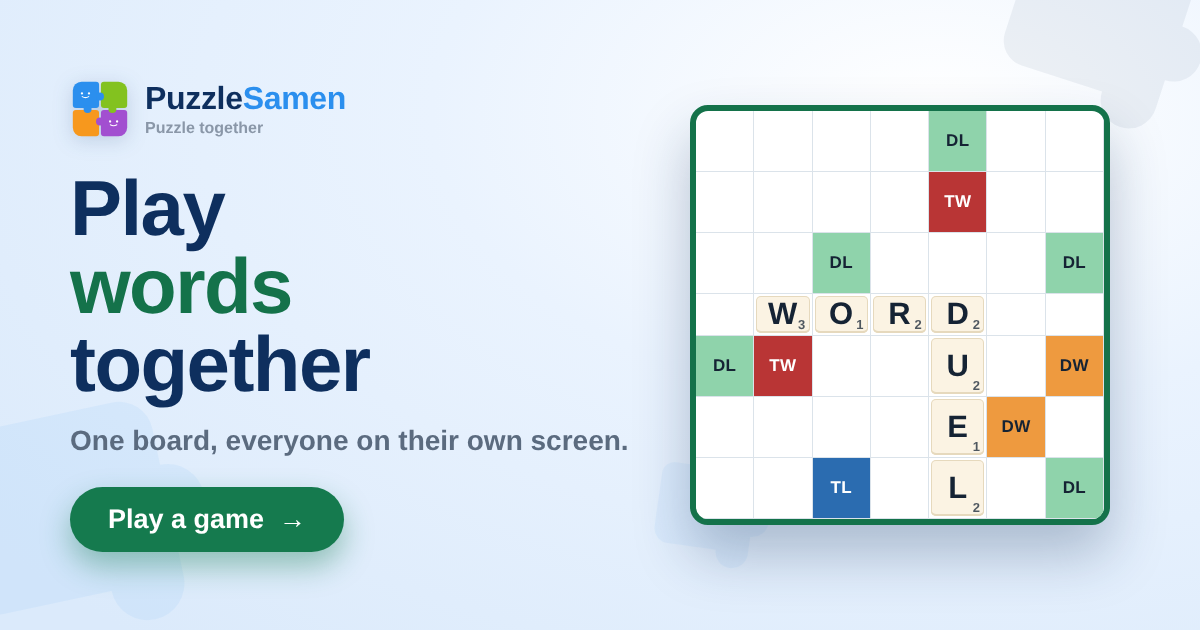
A corner of the Letterio board with the words WORD and DUEL on it, and the colored bonus squares

The rules in short

  1. The first word covers the center square and uses at least two tiles.
  2. Every word after that connects to what is already there: it touches an existing letter, and everything it forms across must be a word too.
  3. All tiles of one move go in one straight line, without a gap — letters already on the board may fill that gap.
  4. After your move you draw back up to seven tiles, and it’s the next player’s turn.
  5. If something is wrong, the game tells you what, and you keep your turn and your tiles.

Instead of playing a word you can also swap (one to seven tiles, as long as at least seven are left in the bag) or pass. The game ends as soon as the bag is empty and someone plays their last tile, or after three passes in a row. The points of the tiles you have left come off your score; whoever plays out gets the others’ leftover points added to theirs.

The tiles and what they’re worth

  • 1 point — E, O, T, A, N, I
  • 2 points — H, S, R, L, U, D
  • 3 points — Y, W, M, G, C
  • 4 points — F, B, P, K
  • 5 points — V
  • 8, 9 and 10 points — J and X, the Z, and the Q
  • 0 points — the blank: it can be any letter but scores nothing itself (a word bonus under it still works as usual)

There are 105 tiles in the bag: 103 letters and 2 blanks. E is the most common (12 tiles), then O and T (9 each); there is just one each of K, V, J, X, Z and Q.

The number of tiles is not copied from another game but worked out from an English word frequency list, built from movie and TV subtitles: the more often a letter turns up in everyday American English, the more tiles of it are in the bag. The points follow the ladder you expect from a word game — 1 to 10 — set on the order from that same count, because a point value that’s different from what you’re used to feels like a mistake rather than a choice.

Where our count says something different from the tables you may know, we keep our own value. Spoken English is full of the, that, you, what and with, so there are more T, H, O, Y and W tiles than usual (9, 6, 9, 3 and 3), H is worth 2 and W and Y 3. A and I turn up less in speech than in a dictionary, so there are 7 and 6 of them. S is 2 points: it sits just below the six most common letters, and a plural may cost something. K is 4 because it is more common than V (5), J is 8 because it is far more common than X, Z and Q, and Z is 9, so only the Q gets the 10.

Bonus squares and the bingo

  • A letter bonus doubles or triples the tile placed on it this turn.
  • A word bonus doubles or triples the whole word it is in.
  • Letter bonuses count first, then the word bonus over the whole word, and then all the words of your move are added up.
  • A bonus square only counts in the turn a tile lands on it — reading across that square again later earns nothing extra.
  • Play all your seven tiles in one turn and you get a bingo: 40 points on top.

On the board a double letter is green, a triple letter blue, a double word orange and a triple word red. Every empty bonus square also carries its label — DL, TL, DW or TW — so you can tell them apart on a small screen and with color blindness too.

The word list: what counts as a word

The game checks every word you form against a list of 170,083 English words, inflected forms included: played, boxes and prettiest are simply in it. Proper nouns, abbreviations and words with a hyphen or a space are not, and capital letters don’t matter.

The list is American, and the British spelling of a word counts too: -our next to -or, -re next to -er, -ise next to -ize. Play whichever spelling you grew up with. A few two-letter words you may know from other games, such as QI and ZA, are not on it.

The list lives on the server, not in your browser. That is on purpose: if it could be downloaded, someone could search it for the best possible word on their rack. So you only find out whether a word exists when you confirm your move.

Sources and licenses

The word list is built from ENABLE (the Enhanced North American Benchmark LExicon, by Alan Beale and M. Cooper), which its makers placed in the public domain. The British spellings come from VarCon (Variant Conversion Info, by Kevin Atkinson and Benjamin Titze), used under its own free license; its copyright notice is in the project documentation.

The number of tiles per letter was worked out from the English word frequency list of FrequencyWords (Hermit Dave, based on OpenSubtitles), used under CC BY-SA 4.0. The same list tells the computer which words are common at its Relaxed and Normal levels.

The board layouts, the point ladder and the game itself are by Puzzle Samen. What you may do with a puzzle from this site is in the terms of use.